
Sheet Metal Gauge Chart
Gauge to mm and inch conversion tables for mild steel, galvanised steel, aluminium, stainless steel and copper — plus minimum bend radii, weight per m² and sheet metal DFM guidelines.

Gauge Conversion Tables
USS (United States Standard) gauge for mild / carbon steel and galvanised steel.
| Gauge | Thickness (mm) | Thickness (in) | Weight (kg/m²) | Min Bend Radius (mm) | Common Use |
|---|---|---|---|---|---|
| 7 | 4.763 | 0.1875 | 37.4 | 4.8 | Heavy structural, frames |
| 8 | 4.166 | 0.1640 | 32.7 | 4.2 | Heavy enclosures |
| 10 | 3.416 | 0.1345 | 26.8 | 3.4 | Structural brackets |
| 11 | 3.048 | 0.1200 | 23.9 | 3.0 | Machine guards |
| 12 | 2.657 | 0.1046 | 20.9 | 2.7 | General fabrication ★ |
| 14 | 1.994 | 0.0785 | 15.7 | 2.0 | Automotive, HVAC |
| 16 | 1.588 | 0.0625 | 12.5 | 1.6 | General purpose ★ |
| 18 | 1.270 | 0.0500 | 10.0 | 1.3 | Enclosures, panels |
| 20 | 0.914 | 0.0360 | 7.2 | 0.9 | Most common gauge ★ |
| 22 | 0.762 | 0.0300 | 6.0 | 0.8 | Lighting, thin panels |
| 24 | 0.635 | 0.0250 | 5.0 | 0.6 | Ductwork, thin shields |
| 26 | 0.457 | 0.0180 | 3.6 | 0.5 | Roofing, gaskets |
| 28 | 0.381 | 0.0150 | 3.0 | 0.4 | Ultra-thin panels |
| 30 | 0.305 | 0.0120 | 2.4 | 0.3 | Foil, heat shields |
★ Most commonly ordered gauges at Survi Engineering. Weight based on density of 7.85 g/cm³.
Brown & Sharpe (AWG) gauge for aluminium alloys (6061, 5052, 3003).
| Gauge | Thickness (mm) | Thickness (in) | Weight (kg/m²) 6061 | Min Bend Radius (mm) | Common Use |
|---|---|---|---|---|---|
| 8 | 3.264 | 0.1285 | 8.8 | 3.3 | Heavy structural |
| 10 | 2.588 | 0.1019 | 7.0 | 2.6 | Brackets, frames |
| 12 | 2.053 | 0.0808 | 5.5 | 2.1 | Aircraft skins |
| 14 | 1.628 | 0.0641 | 4.4 | 1.6 | General fabrication ★ |
| 16 | 1.291 | 0.0508 | 3.5 | 1.3 | Panels, covers |
| 18 | 1.024 | 0.0403 | 2.8 | 1.0 | Most common ★ |
| 20 | 0.812 | 0.0320 | 2.2 | 0.8 | Electronics enclosures |
| 22 | 0.644 | 0.0253 | 1.7 | 0.6 | Thin panels |
| 24 | 0.511 | 0.0201 | 1.4 | 0.5 | Shields, gaskets |
| 26 | 0.405 | 0.0159 | 1.1 | 0.4 | Ultra-thin |
★ Most common gauges. Weight based on 6061 aluminium density 2.70 g/cm³. 5052 and 3003 have similar density.
USS gauge for stainless steel (304, 316, 430). Note: same gauge as mild steel but stainless is lighter per mm due to slightly lower density.
| Gauge | Thickness (mm) | Thickness (in) | Weight (kg/m²) SS304 | Min Bend Radius (mm) | Common Use |
|---|---|---|---|---|---|
| 10 | 3.416 | 0.1345 | 27.2 | 6.8 | Heavy structural (SS) |
| 12 | 2.657 | 0.1046 | 21.2 | 5.3 | Food equipment frames |
| 14 | 1.994 | 0.0785 | 15.9 | 4.0 | Food processing, marine |
| 16 | 1.588 | 0.0625 | 12.7 | 3.2 | Most common SS gauge ★ |
| 18 | 1.270 | 0.0500 | 10.1 | 2.5 | Panels, covers |
| 20 | 0.914 | 0.0360 | 7.3 | 1.8 | Enclosures, trims ★ |
| 22 | 0.762 | 0.0300 | 6.1 | 1.5 | Decorative panels |
| 24 | 0.635 | 0.0250 | 5.1 | 1.3 | Thin shields |
| 26 | 0.457 | 0.0180 | 3.6 | 0.9 | Gaskets, foil |
Brown & Sharpe (AWG) gauge for copper (C110) and brass (C260/C360).
| Gauge | Thickness (mm) | Thickness (in) | Cu Weight (kg/m²) | Brass Weight (kg/m²) | Min Bend Radius (mm) | Common Use |
|---|---|---|---|---|---|---|
| 8 | 3.264 | 0.1285 | 29.2 | 27.7 | 3.3 | Bus bars |
| 10 | 2.588 | 0.1019 | 23.1 | 22.0 | 2.6 | Bus bars, connectors |
| 12 | 2.053 | 0.0808 | 18.3 | 17.4 | 2.1 | Heat exchangers |
| 14 | 1.628 | 0.0641 | 14.5 | 13.8 | 1.6 | General copper sheet ★ |
| 16 | 1.291 | 0.0508 | 11.5 | 10.9 | 1.3 | EMI shielding |
| 18 | 1.024 | 0.0403 | 9.1 | 8.7 | 1.0 | Electrical panels ★ |
| 20 | 0.812 | 0.0320 | 7.2 | 6.9 | 0.8 | Decorative, RF shields |
| 22 | 0.644 | 0.0253 | 5.7 | 5.4 | 0.6 | Thin panels |
| 24 | 0.511 | 0.0201 | 4.6 | 4.3 | 0.5 | Gaskets, foil |
Sheet Metal Fabrication at Survi
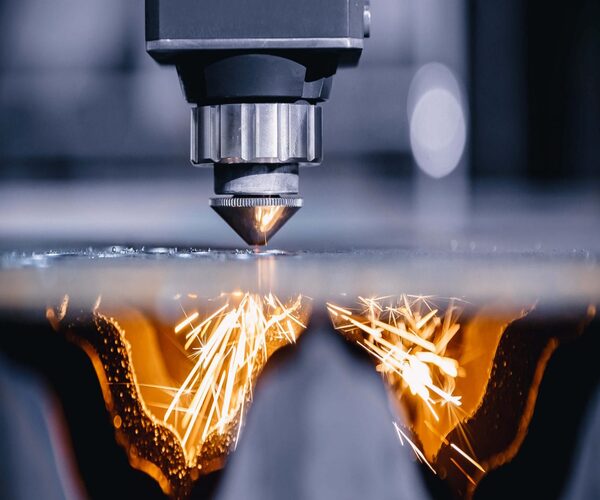
Survi Engineering produces sheet metal parts in mild steel, galvanised steel, aluminium (5052, 6061), stainless steel (304, 316) and copper. Our sheet metal services include fibre laser cutting, CNC press brake forming, spot welding, TIG welding, and deburring — all in-house, giving you a single-source supplier for cut-to-finished parts.
We supply sheet metal parts in quantities from 1 prototype to 5,000+ production pieces. Drawings in DXF (flat pattern) or STEP (3D formed) format are both accepted. If you send us a 3D model, our team unfolds it and optimises the flat pattern for your material and thickness before cutting.
Get a Sheet Metal QuoteMinimum Bend Radii Reference
Minimum inside bend radius depends on material, temper and bending method. As a general rule, the inside radius should be at least equal to the material thickness for ductile metals. Harder materials and large thickness-to-width ratios require larger radii.
| Material | Condition | Min Inside Radius (×t) | Notes |
|---|---|---|---|
| Mild Steel | Cold rolled (CR) | 0.5–1×t | Excellent formability |
| Mild Steel | Hot rolled (HR) | 1–1.5×t | Slightly stiffer |
| Aluminium 5052-H32 | Annealed/H32 | 0.5–1×t | Best formability of Al alloys |
| Aluminium 6061-T6 | T6 temper | 1.5–3×t | Springy — pre-bend and check |
| Aluminium 7075-T6 | T6 temper | 3–5×t | Poor formability — use T73 if bending |
| Stainless 304 | Annealed | 1–2×t | High springback — compensate |
| Stainless 316 | Annealed | 1–2×t | Similar to 304 |
| Copper C110 | H temper | 0.5–1×t | Excellent formability |
| Brass C260 | H62 | 0.5–1×t | Good formability, watch cracking |
| Brass C260 | H80 (hard) | 2–3×t | Brittle at extreme bend angles |
Why Gauge Number Is Not Enough
One of the most common sourcing errors in sheet metal is specifying gauge number without a material qualifier. A "12 gauge" steel sheet is 2.657 mm thick — but a "12 gauge" aluminium sheet is only 2.052 mm thick. The same gauge number gives completely different thicknesses depending on the material family, because different gauge standards (USS for steel, AWG/Brown & Sharpe for aluminium, etc.) evolved independently over a century.
Best practice: always specify thickness in millimetres on your drawing and use gauge only as a secondary reference. This is especially important when sourcing from multiple countries, where gauge conventions may differ. Our team flags any gauge-only callouts before machining begins.

Sheet Metal DFM Tips
Specify thickness in mm, not gauge
Gauge numbers differ by material family. Write "1.5 mm" on your drawing, not "16 gauge" — it removes ambiguity across suppliers.
Keep bend radius ≥ material thickness
Tighter radii crack hard alloys (7075-T6, hard brass). If radius must be tight, use a softer temper or anneal the blank first.
Account for bend allowance
Metal stretches at the bend. Use the K-factor method (K=0.45 for brake bending) or specify the finished flat pattern dimensions on the drawing.
Holes near bends need clearance
Keep hole centres at least 2× material thickness + bend radius from the bend line. Closer holes distort under forming pressure.
Orient grain for bending
Bend perpendicular to the rolling direction where possible — cracking risk is lower. Mark rolling direction on the drawing if orientation matters.
Avoid acute angles in cut-outs
Laser and plasma cutters leave a small radius at internal corners. Specify minimum corner radius ≥ 0.5 mm for laser, 1.5 mm for plasma to avoid stress concentration cracking.

Need Sheet Metal Fabrication?
We cut, bend, weld and finish sheet metal parts in steel, aluminium, stainless steel and copper — from Pune, India at 40–60% lower cost than US or European fabricators.
Frequently Asked Questions
We understand that choosing a manufacturing partner requires clarity and confidence. Here are honest answers to the questions we hear most.
How does Survi offer pricing that is 75% lower than the U.S. and Chinese market?
At Survi, we optimize costs at every stage — from sourcing raw materials in bulk to using highly efficient machining processes and a skilled local workforce in Pune, India. Our overhead is significantly lower than Western manufacturers, and unlike Chinese competitors, we don't compromise on quality or transparency. We pass these savings directly to you, making precision manufacturing accessible without sacrificing standards.
What quality certifications does Survi hold?
Survi Engineering operates under strict quality management practices aligned with ISO 9001 standards. Every part goes through dimensional inspection using calibrated instruments, and we maintain full material traceability. We can provide material test reports (MTRs), first article inspection (FAI) reports, and CMM reports on request. Our quality documentation is built to meet aerospace, medical, and automotive supplier requirements.
What is the typical lead time for CNC machined parts?
Standard lead times are 7–14 business days for most CNC turned and milled parts. Complex multi-setup parts or those requiring special finishing may take 15–20 days. We also offer expedited production for urgent orders — contact us to discuss your timeline. Once your order is confirmed, you'll receive real-time updates on production milestones.
How do I get a quote, and how fast will I receive it?
Getting a quote is simple — upload your 2D drawings (PDF/DXF) or 3D CAD files (STEP/IGES) through our Instant Quote page, specify material, finish, and quantity, and our engineering team will review and respond within 24 hours on business days. For high-volume or complex assemblies, we schedule a brief technical call to ensure the quote is accurate and complete.
What materials and finishes can Survi work with?
We machine a wide range of materials including aluminium alloys (6061, 7075, 2024), stainless steel (303, 304, 316L, 17-4 PH), carbon and alloy steels, titanium (Grade 2 & 5), brass, copper, and engineering plastics (Delrin, PEEK, Nylon). Finishing options include anodizing, hard anodizing, electroless nickel plating, zinc plating, black oxide, powder coating, and precision grinding.
Can Survi handle low-volume prototypes as well as high-volume production?
Yes — we serve both prototyping and production needs. Our minimum order quantity is just 1 piece for prototypes, and we scale efficiently up to tens of thousands of parts for production runs. Prototype pricing reflects the setup costs for small runs, while production pricing benefits from amortized tooling and optimized cycle times. Many clients start with a prototype order and transition to production once designs are validated.
How does Survi ensure my intellectual property and designs are protected?
We take IP protection seriously. All client files and designs are stored securely and never shared with third parties. We are happy to sign a Non-Disclosure Agreement (NDA) before any files are shared. Our internal processes restrict file access to only the engineers working on your specific project, and all digital assets are deleted from our systems upon project completion if requested.